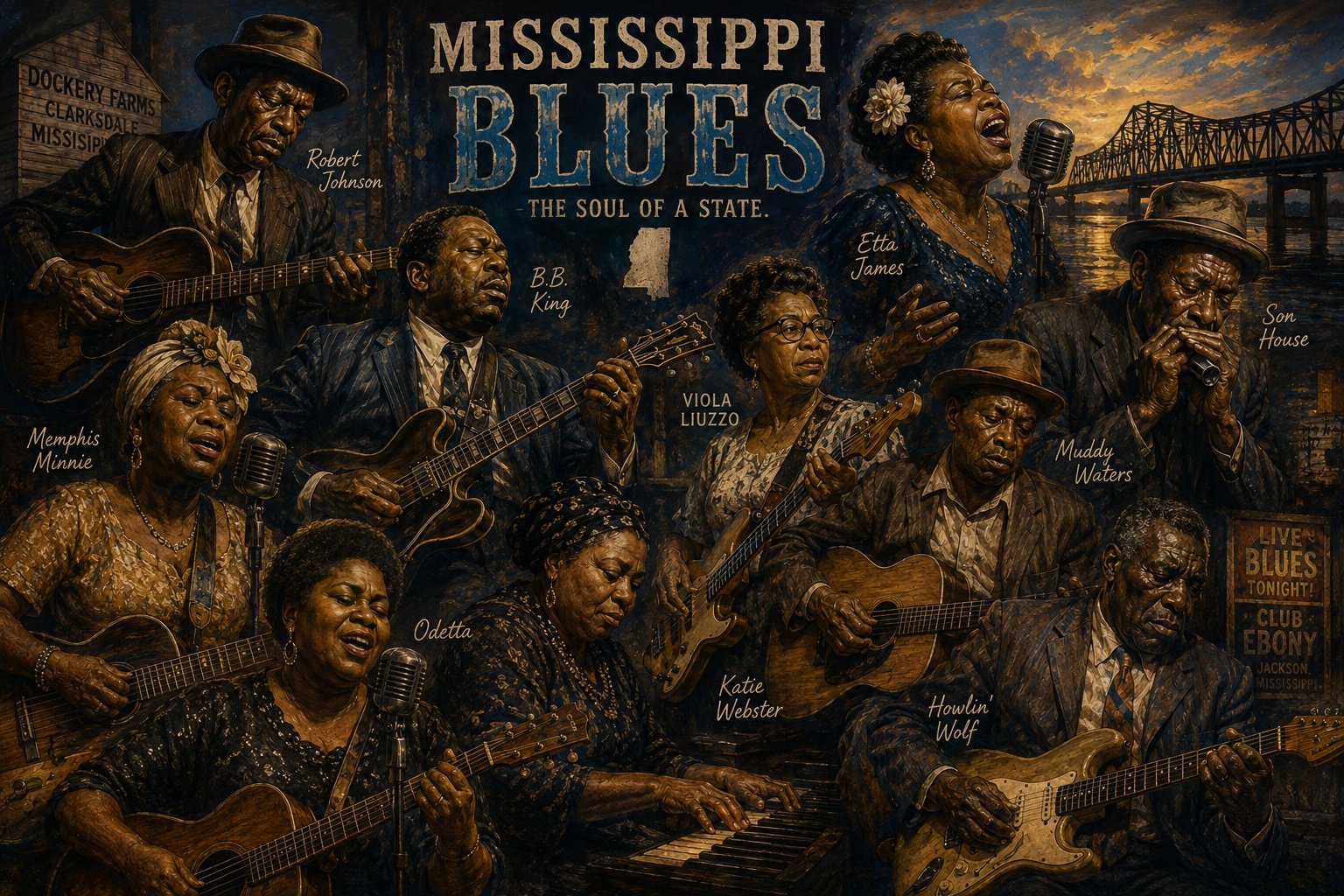
·The Delta Blues Room
No room in the Mississippi Arts Enclave will carry a heavier freight of American history than the Delta Blues Room. This gallery honors the artists who gave the world its most influential musical export — the Delta blues — and in doing so, gave birth to rock and roll, rhythm and blues, soul, and virtually every form of popular music that followed.
The story begins with Charley Patton of Edwards, Mississippi, widely regarded as the Father of the Delta Blues — the first figure to shape the raw, aching sound of the Mississippi Delta into a musical tradition. It continues with Robert Johnson of Hazlehurst, whose brief career and twenty-nine surviving recordings became one of the most analyzed and revered bodies of work in American music, influencing Muddy Waters, Eric Clapton, the Rolling Stones, and Bob Dylan. It deepens with Elmore James of Richland, whose electrifying slide guitar style was so distinctive and so powerful that it defined a generation of electric blues players. And it reaches its fullest expression in B.B. King of Itta Bena — the undisputed King of the Blues — and Muddy Waters of Issaquena County, the man who carried the Delta sound to Chicago, amplified it, and handed it to the world.
The Delta Blues Room will also honor Howlin’ Wolf of White Station, whose voice was one of the most visceral and commanding in the history of recorded music; Bo Diddley of McComb, whose syncopated “Bo Diddley beat” became one of the most sampled rhythmic patterns in all of popular music and shaped the guitar styles of Buddy Holly, Jimi Hendrix, and Bruce Springsteen; John Lee Hooker of Clarksdale, whose hypnotic, droning blues became a touchstone for two generations of rock musicians; and Skip James of Bentonia, whose haunting falsetto and minor-key guitar work stand as some of the most otherworldly recordings ever made on American soil.
These are not regional curiosities. They are the architects of modern music. The Delta Blues Room will present their stories with the depth, dignity, and scholarly seriousness they have earned — and in doing so, will tell the story of how a small, poor state in the American South changed the sound of the entire world.